


Crime, a persistent concern across the United States, manifests uniquely in each state, and Colorado is no exception.
Understanding crime rates in Colorado is not only about going through statistics but also about grasping the underlying factors and exploring effective solutions.
This article delves into the latest crime data, dissects the causes, and highlights the initiatives in place to ensure the safety and well-being of Colorado’s residents.
Overview of Current Crime Rates in Colorado
Colorado’s crime landscape: 47% increase in total yearly crimes, violent crime rates at a 25-year high, leading the nation in property crime rate at 31.4 per 1,000 people in 2023, 17% rise in violent crimes from 2019-2021, and a significant 13.6% jump in motor vehicle thefts in 2022.
Recent years have seen fluctuating crime rates in Colorado. According to the Colorado Bureau of Investigation, there was a noticeable increase, particularly in burglary and auto theft.
During recent years, the Crime rate in Colorado has been as follows:
- The total yearly crimes in Colorado grew by 47% or 131,399 annual offenses. Source: CBS News
- 30% of Coloradans reported being victims of property crime, in line with the national average. Source: SafeWise
- There was an 18% increase in aggravated assaults in 2020, contributing to the state’s growth in violent crime. Source: The Denver Post
- Colorado saw a significant increase in auto thefts and property crimes, topping the nation. Source: Colorado Politics
- The rate of parole grew, and the number of class 5 crimes resulting in parole increased significantly. Source: Common Sense Institute Colorado
- Colorado experienced a considerable increase in violent crime rates between 2019 and 2021. Source: Colorado Public Radio (CPR)
- Colorado’s violent crime rate reached a 25-year high. Source: Axios Denver
- Significant changes in marijuana-related crimes and their impacts. Source: Colorado Department of Public Safety
Types of Crimes in Colorado
Colorado faces a diverse range of criminal activities, including drug trafficking, human trafficking, and property crimes.
Violent Crime Rates
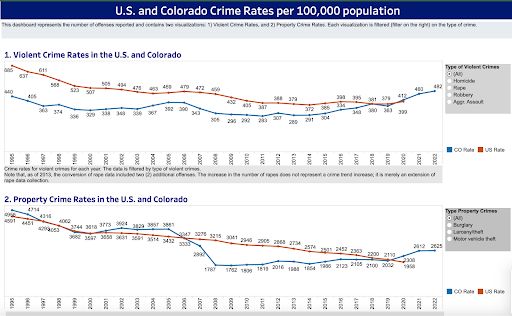
In 2023, Colorado’s violent crime rate was 4.8, which is slightly above the national average and represents a 14% increase compared to the previous year. This rate is the ninth-highest in the nation. Notably, rape accounts for 15% of violent crime in Colorado, higher than the national average.
Property Crime Rates
Colorado experienced the highest property crime rate in the nation during 2023, with 31.4 property crimes per 1,000 people. This is an 11% increase from the previous year and significantly higher than the national average property crime rate of 19.3.
Trends in Specific Crimes
Between 2019 and 2021, violent crime in Colorado, which includes murders, serious assaults, sex assaults, and robberies, rose by 17%.
In comparison, the state’s property crime rate has remained mostly stable since 2008 despite a 5% increase in 2020.
The rate of robberies and aggravated assaults has also seen a notable increase, particularly in urban areas like Aurora. Source: Colorado.gov
Impact of the Pandemic
According to a report by SafeWise, approximately 47% of Colorado residents say their safety has been affected by the pandemic, which is slightly higher than the national average.
The pandemic has also influenced the security of properties, with 30% of Colorado residents noting an impact on their property security.
Geographical Variations
Urban centers like Denver and Colorado Springs often report higher crime rates, especially in theft and burglary, compared to rural areas.
Crime rates in Colorado vary significantly depending on the region.
Key observations include
Cities like Denver and Colorado Springs tend to have higher crime rates, particularly in theft and burglary.
Rural areas generally experience lower crime rates but may face challenges with drug-related offenses and limited law enforcement resources.
In urban areas like Denver and Colorado Springs, crime rates, particularly for violent crimes and property crimes, are notably higher compared to rural areas. This trend is supported by findings from the Bureau of Justice Statistics (BJS) as reported in the City Journal. The BJS data revealed that the rate of violent crime in urban areas rose 29 percent from 2020 to 2021. The violent crime rate in urban areas was found to be 121 percent higher than in rural areas in 2021, and the property crime rate was nearly three times as high in urban areas compared to rural areas.
Meanwhile, rural areas in Colorado generally experience lower crime rates but are not immune to criminal activities. Challenges such as drug-related offenses and limited law enforcement resources are more prevalent in these areas. However, the overall victimization rates for both violent and property crimes are significantly lower in rural areas compared to urban settings. In 2021, the rate of violent victimization in urban areas was more than double that in rural areas, according to USAFacts.
Furthermore, Colorado Public Radio highlights the overall increase in various types of crime across the state, including a 17 percent rise in violent crime between 2019 and 2021. The report also touches upon the challenges faced by law enforcement and the implications of policy changes on crime rates.
Understanding these variations in crime rates is crucial for developing effective crime prevention and intervention strategies tailored to the specific needs of urban and rural communities in Colorado. This data underscores the importance of context-specific approaches to address the distinct challenges faced by different regions within the state.
In 2022, Colorado continued to experience significant crime challenges. Key statistics include a 0.2% increase in robbery, 5% in arson, and a notable 13.6% rise in motor vehicle theft. Additionally, there was a 1.9% increase in drug possession and sales. Despite some fluctuations, crime rates in several major categories remained elevated above pre-pandemic levels, with motor vehicle theft showing an alarming 111.6% increase compared to pre-pandemic figures. Notably, Colorado remained the number one state for motor vehicle theft and ranked second in crimes against property.
For more detailed information on Colorado’s crime rates and trends in 2022, you can visit the Common Sense Institute’s report on Colorado’s Increasing Crime Problem.
Impact of High Crime On Communities
Crime in Colorado affects communities in various ways:
- High crime rates can lead to a sense of insecurity and affect the overall quality of life. People who live in areas with high crime rates may feel afraid to go out at night, walk to their car, or let their children play outside. This can lead to a decrease in social interaction and a feeling of isolation. It can also make it difficult to attract businesses and residents to the area, which can further contribute to the decline of the community.
- Areas with high crime rates often face challenges in attracting businesses and maintaining property values. Businesses are less likely to want to locate in areas where there is a high risk of crime. This can lead to a decrease in economic activity and a decline in property values.
- Persistent crime can strain community relations and trust in law enforcement. When people feel that their community is unsafe, they may become less likely to cooperate with the police. This can make it difficult for law enforcement to effectively address crime and can lead to a cycle of distrust and fear.Friday

In addition to the above, crime can also have a negative impact on the physical environment of a community. For example, abandoned buildings and vacant lots are often associated with crime. These eyesores can make a community feel unsafe and unattractive, which can further contribute to its decline.
How Can We Help? Collaboration for a Safer Colorado
As we navigate the complexities of crime in Colorado, it’s clear that a multi-faceted approach is necessary. From community initiatives to the strategic use of private investigators, every effort counts towards making Colorado a safer place.
At Privin Network, we understand the critical role that private investigation plays in this equation. Our expertise is not just about solving cases – it’s about empowering communities and businesses, restoring peace of mind, and fostering an environment where safety is a priority.
Comprehensive Investigation Services for Your Unique Needs
- Personalized Solutions – Every case is unique, and so are our solutions. Whether you’re dealing with theft, fraud, missing persons, or any other concern, our team is equipped with the skills and resources to handle it.
- Business and Corporate Services – For businesses, we offer a range of specialized services including background checks, fraud investigations, and risk assessments, all designed to protect your assets and reputation.
- Community Support – Beyond individual cases, we’re committed to supporting community initiatives aimed at crime prevention and safety enhancement.
Interested in exploring how private investigation can assist you or your business?
Contact us at Privin Network for a confidential free consultation and discover tailored solutions to your security needs.
FAQs: Understanding Crime Rates in Colorado
1. What is the current violent crime rate in Colorado?
In 2023, Colorado’s violent crime rate was 4.8 per 1,000 residents, slightly above the national average. This marked a 14% increase compared to the previous year, positioning Colorado as having the ninth-highest violent crime rate in the nation. Notably, rape accounted for 15% of violent crimes in Colorado, which is higher than the national average.
2. How has the property crime rate changed in Colorado?
Colorado experienced a significant rise in property crimes, with a 47% increase in total annual offenses, amounting to an additional 131,399 crimes. The state led the nation in property crime rates, with 31.4 incidents per 1,000 people in 2023. Additionally, 30% of Coloradans reported being victims of property crime, aligning with the national average.
3. What trends have been observed in motor vehicle thefts?
Motor vehicle thefts in Colorado saw a notable 13.6% increase in 2022. This uptick contributed to the state’s overall rise in property crimes, reflecting broader national concerns about vehicle-related offenses.
4. How do Colorado’s crime rates compare to national averages?
Colorado’s violent crime rate of 4.8 per 1,000 residents is slightly above the national average. However, the state has experienced a 14% increase in violent crimes from the previous year. In contrast, property crime rates in Colorado have surged by 47%, outpacing national trends.
5. What initiatives are being implemented to address rising crime rates?
In response to escalating crime rates, Colorado has introduced several measures, including:
- Enhanced Law Enforcement Resources: Increasing funding and support for local police departments to bolster crime prevention and response efforts.
- Community Engagement Programs: Initiatives aimed at fostering collaboration between law enforcement and communities to address underlying causes of crime.
- Legislative Actions: Enacting laws to strengthen penalties for certain offenses and improve the criminal justice system’s effectiveness.